
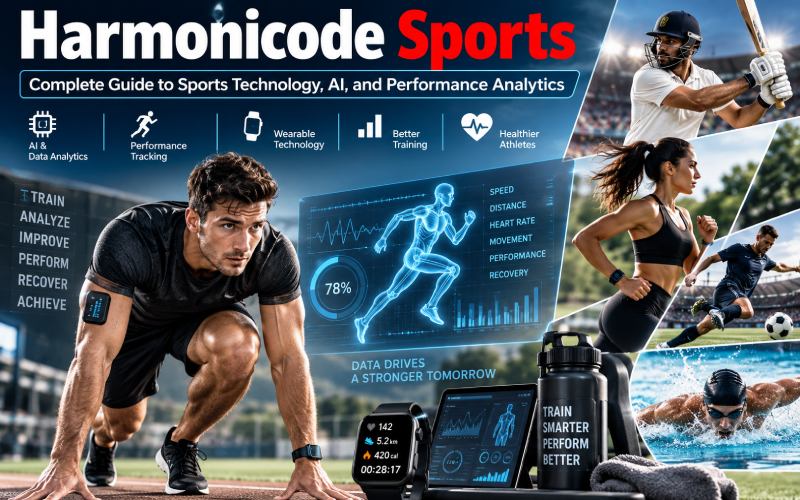
Sports are changing rapidly as technology becomes a bigger part of training, performance analysis, coaching, recovery, and fan engagement. One term appearing in this growing conversation is Harmonicode Sports.
Unlike traditional sports terminology, Harmonicode Sports does not currently have one universally accepted industry definition. Online sources use the term in different ways, but it is most commonly associated with the intersection of athletic performance, biomechanics, artificial intelligence, wearable technology, data analytics, rhythm, and movement patterns.
In simple terms, Harmonicode Sports can be understood as a modern sports-technology concept focused on using data and digital tools to better understand how athletes move, train, recover, and perform.
This guide explains what Harmonicode Sports means, how the concept may work, its connection with AI and sports analytics, potential applications, limitations, and what its future could look like.
What Is Harmonicode Sports?
Harmonicode Sports is an emerging term generally used to describe a data-driven approach to athletic performance.
The idea combines several areas of modern sports technology, including:
- Athlete performance data
- Biomechanical analysis
- Artificial intelligence
- Machine learning
- Wearable sensors
- Movement tracking
- Training analytics
- Real-time feedback
- Recovery monitoring
- Team performance analysis
The word “harmonicode” itself suggests the combination of harmony and code.
In a sporting context, “harmony” can represent coordinated movement, timing, balance, rhythm, and efficient physical performance, while “code” represents the data, software, algorithms, and analytical systems used to interpret those movements.
Rather than relying only on observation, this approach attempts to make athletic performance more measurable.
Why Is Harmonicode Sports Gaining Attention?
Modern athletes generate more performance data than ever before.
Smartwatches, GPS devices, heart-rate monitors, motion sensors, cameras, and training platforms can collect information about speed, distance, workload, movement, recovery, and other performance-related factors.
At the same time, artificial intelligence and machine-learning systems are making it easier to analyze large amounts of data.
This combination has helped create interest in concepts such as Harmonicode Sports.
Instead of simply asking whether an athlete performed well, data-driven systems can potentially help coaches examine questions such as:
- How consistently is an athlete moving?
- Is training intensity changing?
- Which techniques appear most efficient?
- How does performance vary across training sessions?
- Are movement patterns becoming more consistent?
- Where may additional coaching attention be useful?
Technology does not automatically answer every question correctly, but it can provide additional information for athletes and coaches to consider.
How Harmonicode Sports Works
There is no single standardized Harmonicode Sports system, so the exact process depends on how the term is being used.
However, a typical sports-performance workflow may involve four major stages.
1. Data Collection
The first step is collecting information about an athlete or team.
Data may come from:
- Wearable fitness devices
- GPS trackers
- Motion sensors
- Video recordings
- Training apps
- Timing systems
- Performance-testing equipment
- Manual coaching observations
The quality of the final analysis depends heavily on the quality and consistency of the data being collected.
2. Movement and Performance Analysis
Once data has been collected, software can organize and analyze it.
For example, a system might examine:
- Acceleration
- Speed
- Direction changes
- Movement timing
- Training volume
- Repetition consistency
- Balance
- Coordination
- Performance trends
Video analysis may also allow coaches to compare movements across different training sessions.
3. Pattern Recognition
This is where AI and machine learning may become useful.
Algorithms can search large datasets for recurring patterns that may be difficult to notice manually.
For example, a coach may want to understand whether certain movement patterns appear repeatedly when an athlete becomes tired.
These systems should generally be viewed as decision-support tools rather than replacements for qualified coaches, trainers, or medical professionals.
4. Feedback and Adjustment
The final stage involves turning data into useful feedback.
Athletes and coaches may use the information to adjust:
- Training intensity
- Technique
- Practice schedules
- Recovery periods
- Skill-development drills
- Tactical preparation
Collecting data alone provides limited value if the information cannot be translated into meaningful decisions.
Key Technologies Associated With Harmonicode Sports
The Harmonicode Sports concept overlaps with several established sports-technology categories.
Artificial Intelligence
AI can help process large amounts of training and performance information.
Depending on the application, AI tools may identify patterns, organize video, compare historical performance, or create data summaries.
However, the usefulness of AI depends on the quality of the underlying information and how responsibly the results are interpreted.
Machine Learning
Machine-learning systems can identify relationships in datasets and improve certain analytical tasks as more relevant information becomes available.
In sports, this may be useful for analyzing repeated movements, identifying performance patterns, or comparing training sessions.
Wearable Technology
Wearable devices have become common across both professional and recreational sports.
Depending on the device, wearables may track metrics such as:
- Heart rate
- Distance
- Speed
- Training duration
- Movement
- Sleep-related information
- Activity levels
The accuracy and purpose of these measurements vary between devices.
Motion Tracking
Motion-tracking technology can help analyze how an athlete moves.
Cameras, sensors, and specialized software may examine elements such as posture, body position, timing, acceleration, and movement sequences.
This information can be particularly useful when combined with experienced coaching analysis.
Sports Analytics
Sports analytics involves using data to understand performance.
Analytics can be applied to individual athletes, entire teams, tactical decisions, training sessions, and competitions.
Harmonicode Sports fits naturally within this broader move toward data-informed athletics.
Harmonicode Sports and Biomechanics
Biomechanics examines movement and the mechanical principles involved in how the body performs physical activities.
Modern sports technology can help capture movement data that would be difficult to measure through observation alone.
Depending on the sport and technology being used, analysis may focus on:
- Running mechanics
- Throwing motion
- Jumping technique
- Swing mechanics
- Body positioning
- Joint movement
- Changes of direction
- Repetitive movement patterns
However, collecting biomechanical data and correctly interpreting that information are different tasks.
Professional assessment may still be necessary when information is being used for injury management, rehabilitation, or medical decision-making.
Harmonicode Sports in Individual Sports
Individual athletes may use performance technology to better understand their own training.
Running
Runners may track pace, distance, cadence, heart rate, and training load.
Over time, these measurements can help create a clearer picture of training consistency.
Cycling
Cyclists frequently use digital tools to monitor speed, distance, cadence, elevation, power-related metrics, and workout duration.
Tennis
Video and sensor technology can potentially help analyze footwork, serving patterns, swing mechanics, and movement around the court.
Swimming
Performance analysis may focus on lap times, stroke rate, distance per stroke, starts, turns, and overall consistency.
Different sports require different metrics, which is why data should always be interpreted within the context of the activity.
Harmonicode Sports in Team Sports
Data analytics can become even more complex when multiple athletes are involved.
In sports such as football, basketball, cricket, hockey, or soccer, performance tools may help teams analyze:
- Player movement
- Training workload
- Positioning
- Speed
- Tactical patterns
- Passing or possession data
- Practice intensity
- Team performance trends
Coaches can combine these measurements with direct observation and game knowledge.
Technology can provide additional information, but strategy still depends heavily on context, opposition, athlete roles, and coaching judgment.
Harmonicode Sports and Esports
The concept can also overlap with competitive gaming.
Although esports competitors are not performing the same physical movements as traditional athletes, their performance may still depend on:
- Reaction time
- Hand-eye coordination
- Decision-making speed
- Accuracy
- Consistency
- Communication
- Concentration
Some current online discussions of Sports Harmonicode also connect the concept with gaming and esports performance.
Analytics tools can track in-game performance and help players review previous matches, identify repeated mistakes, and study tactical decisions.
Potential Benefits of Harmonicode Sports
If used responsibly, data-driven sports technology can offer several potential advantages.
More Detailed Performance Tracking
Instead of relying entirely on memory or visual observation, athletes can review measurable information from previous sessions.
More Personalized Training
Different athletes respond differently to training.
Individual performance data can help coaches better understand those differences when designing programs.
Faster Feedback
Some modern training technologies can provide information shortly after or even during a training session.
This can make it easier to review technique while the activity is still fresh.
Improved Training Consistency
Historical data makes it possible to compare performance across days, weeks, or longer periods.
Better Communication
Performance dashboards and visual data can sometimes make it easier for coaches and athletes to discuss specific aspects of training.
Limitations of Harmonicode Sports
Technology should not be treated as automatically accurate or authoritative.
There are several limitations users should consider.
Data Can Be Misleading
Poor-quality sensors, incorrect measurements, or inconsistent data collection can produce unreliable conclusions.
More Data Does Not Always Mean Better Decisions
Collecting hundreds of metrics is not necessarily useful.
Athletes and coaches need to identify which information actually matters.
Human Context Still Matters
Numbers may show what happened, but they do not always explain why it happened.
Fatigue, travel, weather, competition level, strategy, equipment, and many other factors may affect performance.
Privacy Is Important
Athletic data can include personal and potentially sensitive information.
Organizations collecting athlete information should consider security, consent, access, and responsible data use.
AI Can Make Mistakes
Artificial intelligence identifies patterns based on available data. It should not automatically be treated as an expert conclusion.
Human review remains important.
Harmonicode Sports vs Traditional Training
| Area | Harmonicode Sports Approach | Traditional Approach |
|---|---|---|
| Performance evaluation | Data plus observation | Primarily observation |
| Feedback | Can be rapid or data-assisted | Coach-led |
| Tracking | Digital historical records | Notes and observation |
| Movement analysis | Sensors, video, analytics | Visual analysis |
| Personalization | Data-assisted | Coach experience |
| Technology requirement | Often required | Limited |
| Human coaching | Still important | Central |
The two approaches do not need to compete.
The most practical model may be to combine experienced coaching with useful technology instead of attempting to replace one with the other.
Is Harmonicode Sports a Real Technology?
This question needs some clarification.
At present, Harmonicode Sports is not a universally standardized scientific or sports-industry term. Different websites currently describe it in different ways. Some present it as a platform, while others use it as a broader concept involving AI, biomechanics, data, rhythm, and athletic performance.
Readers should therefore be cautious about treating every claim made under the Harmonicode Sports name as scientifically established.
When evaluating any sports technology, look for clear information about:
- Who created the technology
- What the product actually measures
- How measurements are collected
- Whether claims are supported by reliable evidence
- How athlete data is stored
- Whether independent research exists
- What limitations the company acknowledges
This makes it easier to separate useful sports technology from marketing claims.
The Future of Harmonicode Sports
Whether or not Harmonicode Sports becomes a standardized industry term, the technologies associated with the concept are likely to remain important in modern athletics.
Sports performance is increasingly connected with digital measurement.
Future systems may become better at combining information from multiple sources, including video, wearables, training records, competition data, and athlete feedback.
AI may also make sports analytics easier to understand by converting complicated datasets into simpler summaries for athletes and coaches.
The biggest opportunity will not necessarily come from collecting more information.
It will come from identifying which information is genuinely useful and presenting it in a way that improves decision-making.
Frequently Asked Questions
What does Harmonicode Sports mean?
Harmonicode Sports is an emerging online term commonly associated with the combination of sports, performance data, biomechanics, artificial intelligence, wearable technology, movement analysis, and digital coaching tools.
Is Harmonicode Sports related to fencing?
Current search usage primarily associates Harmonicode Sports with sports technology and performance analytics rather than concertina, razor-wire, or perimeter fencing.
Is Harmonicode Sports an AI technology?
AI is commonly associated with the concept, but Harmonicode Sports does not currently have one standardized definition. Different sources use the term in different ways.
How can Harmonicode Sports help athletes?
Data-driven sports systems may help athletes monitor performance, compare training sessions, review technique, and receive more detailed feedback.
Actual benefits depend on the quality of the technology, the data being collected, and how the information is interpreted.
Can Harmonicode Sports prevent injuries?
Sports technology may help identify workload or movement information that coaches and specialists can consider, but it should not be assumed to predict or prevent every injury.
Injury diagnosis, treatment, and rehabilitation decisions should involve appropriately qualified healthcare professionals.
Does Harmonicode Sports replace a coach?
No. Technology can provide additional information, but experienced coaches provide context, communication, strategy, motivation, and judgment that software cannot fully replace.
Can beginners use sports analytics?
Yes. Many consumer fitness devices and sports apps provide basic performance information.
Beginners should focus on useful metrics rather than trying to monitor every available measurement.
Is Harmonicode Sports useful for esports?
The broader concept can also be applied to esports, where analytics may be used to review reaction time, accuracy, consistency, decision-making, and in-game performance.
Conclusion
Harmonicode Sports represents an emerging way of thinking about the relationship between athletics and technology.
Rather than describing fencing systems, the term is now more commonly associated online with sports analytics, AI, biomechanics, wearable technology, movement patterns, and data-driven performance.
The central idea is straightforward: better information may help athletes and coaches better understand performance.
However, technology should support—not replace—human expertise.
Athletes should focus on reliable measurements, meaningful performance indicators, qualified coaching, responsible data use, and realistic expectations about what AI and analytics can achieve.
As sports technology continues to develop, concepts such as Harmonicode Sports highlight a broader shift toward combining human athletic ability with smarter digital analysis.