
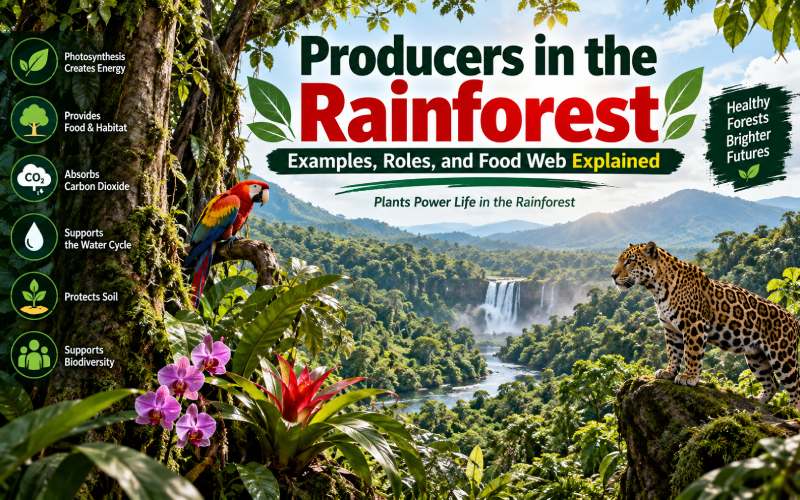
Producers in the rainforest are the foundation of the entire tropical ecosystem. From enormous trees rising above the canopy to small ferns and mosses growing in shaded areas, these organisms capture sunlight and convert it into energy that supports countless forms of life.
When people think about rainforests, animals such as jaguars, monkeys, toucans, snakes, and frogs often receive most of the attention. Yet none of these animals could survive without plants and other photosynthetic organisms at the base of the food web.
Rainforest producers provide food, shelter, oxygen through photosynthesis, carbon storage, soil protection, and habitat for an extraordinary variety of species. Understanding them makes it easier to understand how the rainforest ecosystem works as a whole.
What Are Producers in the Rainforest?
In ecology, a producer is an organism that can make its own food.
Most rainforest producers are green plants that use photosynthesis. During this process, plants use sunlight, water, and carbon dioxide to produce sugars that provide energy for growth.
Because producers create usable biological energy from sunlight, they form the first major level of most rainforest food chains.
Trees are the most obvious examples, but rainforest producers also include vines, palms, orchids, bromeliads, ferns, mosses, algae, and many aquatic plants.
Why Are Rainforest Producers So Important?
Producers do far more than make leaves and fruit.
They create the biological material that supports herbivores. Those herbivores are then eaten by predators, transferring energy through the ecosystem.
A fruit tree may feed birds, monkeys, insects, bats, and rodents. Those animals can then become food for snakes, wild cats, birds of prey, and other predators.
Rainforest vegetation also creates physical habitats. Tree trunks, branches, leaves, roots, flowers, and cavities provide nesting sites, shelter, feeding areas, and breeding spaces.
Large forests also interact with the carbon and water cycles. Trees absorb carbon dioxide during photosynthesis and store carbon in their tissues. They also return water to the atmosphere through transpiration.
This means rainforest producers influence far more than the organisms living directly beside them.
The Four Layers of the Rainforest
A tropical rainforest is not simply one continuous wall of vegetation.
It is commonly described as having four major vertical layers: the emergent layer, canopy, understory, and forest floor.
Each receives different amounts of sunlight, wind, and moisture, so plants living in each layer require different adaptations.
Emergent Layer
The emergent layer contains the tallest trees.
These trees rise above the main canopy and receive strong sunlight. They also experience higher winds and more exposure than plants growing below.
Kapok Tree
The kapok tree is one of the best-known examples of a large tropical rainforest producer.
Its great height allows its upper leaves to receive abundant sunlight, while its trunk and branches provide habitat for many animals and smaller plants.
Brazil Nut Tree
Brazil nut trees can also grow very tall in Amazonian forests.
Their flowers, fruits, and seeds connect them with pollinating insects, seed-dispersing animals, and other organisms within the ecosystem.
Canopy Layer
The canopy is formed by the crowns of many rainforest trees growing close together.
It functions like a roof over the layers beneath it, intercepting much of the sunlight before it can reach the forest floor.
The canopy contains an enormous amount of plant and animal activity.
Lianas
Lianas are woody vines that begin growing from the ground but use trees for support as they climb toward brighter parts of the forest.
Because they photosynthesize, they are producers.
Their climbing growth strategy allows them to reach sunlight without investing as much energy in building thick, self-supporting trunks.
Epiphytes
Epiphytes grow on other plants, usually on trunks and branches.
Unlike parasites, typical epiphytes use the host mainly for support rather than taking food directly from it.
Orchids, bromeliads, mosses, and some ferns can grow as epiphytes.
Living higher in the forest can give them better access to sunlight, rainfall, and pollinators.
Understory Layer
The understory is located below the main canopy.
Sunlight is much more limited here, so plants must be adapted to relatively shaded conditions.
Common understory producers include young trees, palms, heliconias, shrubs, ferns, and other shade-tolerant species.
Some plants develop broad leaves that help capture available light.
Young trees may remain relatively small for years while waiting for a gap in the canopy to provide stronger sunlight.
Forest Floor
The forest floor receives relatively little direct sunlight.
Because of this, plant growth can be less dense than people sometimes imagine.
Ferns, mosses, seedlings, shade-tolerant plants, and algae can survive in suitable areas.
The forest floor is also an important location for decomposition.
Dead leaves, fallen branches, fruit, and other organic material are broken down by fungi, bacteria, insects, and other organisms. Nutrients can then be recycled through the ecosystem.
10 Examples of Producers in the Rainforest
Rainforests contain thousands of plant species, but some common examples help explain the different forms producers can take.
These include kapok trees, Brazil nut trees, strangler figs, palms, lianas, orchids, bromeliads, heliconias, ferns, and mosses.
Aquatic environments within rainforest regions also contain producers such as algae, phytoplankton, grasses, floating plants, and water lilies.
Strangler Fig
The strangler fig has one of the rainforest’s most interesting growth strategies.
A seed may begin growing high in another tree after being deposited by a bird or other animal.
The young fig sends roots downward toward the ground. Over time, the plant grows around its host and competes with it for light, water, and space.
Eventually, the original host tree may decline while the fig becomes a large independent tree.
Despite its aggressive growth pattern, the strangler fig is a producer because its green leaves perform photosynthesis.
Bromeliads
Many bromeliads grow on rainforest trees as epiphytes.
Some species have leaves arranged in a shape that collects rainwater.
These small pools may provide habitat for insects, frogs, and other tiny organisms.
Bromeliads gain energy through photosynthesis while obtaining water and nutrients from their environment.
Orchids
Many tropical orchids grow high on branches.
They are often mistaken for parasites, but most epiphytic orchids do not take food directly from their host tree.
Instead, they use the tree as physical support while obtaining moisture and nutrients from rain, air, debris, and organic material around their roots.
Ferns
Ferns are common in humid forest environments.
Unlike flowering plants, they reproduce using spores, but their green fronds still perform photosynthesis.
This makes them producers.
Mosses
Mosses may appear small compared with rainforest trees, but they still play a role in the ecosystem.
They can grow on soil, rocks, trunks, and branches where moisture is available.
Like other green plants, mosses capture energy through photosynthesis.
Aquatic Producers in Rainforest Ecosystems
Rainforests also contain rivers, wetlands, ponds, streams, and seasonally flooded areas.
These habitats support aquatic producers such as algae and aquatic plants.
One well-known South American example is the giant water lily, Victoria amazonica, which is associated with the Amazon Basin.
Aquatic producers provide food and habitat for organisms living in and around rainforest waterways.
How Rainforest Producers Adapt to Survive
Rainforests appear ideal for plants because they are warm and wet, but competition can be intense.
One of the biggest challenges is sunlight.
Plants growing beneath the canopy receive far less direct light than the tallest trees.
Different species have therefore developed specialized adaptations.
Large Leaves
Many shade-tolerant plants have broad leaves that increase the surface area available for capturing limited light.
Drip Tips
Some rainforest leaves have pointed ends that help water drain from their surfaces.
This can be useful in environments where rainfall and moisture are frequent.
Buttress Roots
Some large tropical trees develop broad roots extending outward around the base of the trunk.
These structures help support very tall trees.
Climbing Growth
Vines such as lianas climb trees to reach brighter areas instead of building enormous supporting trunks of their own.
Epiphytic Growth
Epiphytes solve the sunlight problem in another way: they begin growing above the ground on other plants.
This places them closer to brighter parts of the forest.
Are Carnivorous Plants Still Producers?
Yes.
Some carnivorous plants trap insects and other small organisms, but they still obtain their main energy through photosynthesis.
The insects generally provide additional nutrients, particularly in environments where certain nutrients are difficult to obtain from the soil.
Therefore, carnivorous plants that photosynthesize are still classified as producers.
Producers, Consumers, and Decomposers
A rainforest ecosystem depends on interaction between these three broad ecological groups.
Producers capture energy and create organic matter. Trees, vines, ferns, and other green plants belong to this group.
Consumers obtain energy by eating producers or other consumers. Monkeys, sloths, insects, birds, snakes, and jaguars are examples.
Decomposers break down dead biological material and help recycle nutrients. Fungi and bacteria are major examples.
Together, they keep nutrients and energy moving through the ecosystem.
Primary Consumers in the Rainforest
Primary consumers feed directly on plants or plant material.
A caterpillar eating a leaf is a primary consumer.
A fruit-eating animal can also function as a primary consumer when it feeds on fruit.
Sloths, some insects, tapirs, rodents, and many fruit-eating animals can occupy this level of the food web.
However, many rainforest animals eat a varied diet, so their exact trophic level can change depending on what they consume.
Secondary Consumers
Secondary consumers eat primary consumers.
A frog eating plant-eating insects is one simple example.
Small snakes, insect-eating birds, spiders, and some reptiles can also function as secondary consumers.
Tertiary Consumers in the Rainforest
Tertiary consumers feed higher in the food web.
Depending on the specific ecosystem and diet, examples can include jaguars, harpy eagles, large snakes, and other major predators.
These animals may influence populations of species below them and contribute to the ecological balance of the forest.
Example of a Rainforest Food Chain
A simplified rainforest food chain could look like this:
Green plant → Herbivorous insect → Frog → Snake → Bird of prey
Another example might be:
Fruit tree → Fruit-eating mammal → Jaguar
Real rainforest food webs are much more complicated because most animals interact with several different plants and prey species.
Still, both examples demonstrate the same important principle: energy enters the food web through producers.
Is Rafflesia a Producer?
Rafflesia is often included incorrectly in lists of rainforest producers.
It is a highly unusual parasitic plant.
Rafflesia arnoldii does not have normal leaves, roots, or stems and lives within a host vine. It depends on its host for water and nutrients instead of functioning like a normal green photosynthetic plant.
For this reason, it should not be used as a standard example of a rainforest producer.
Are Fungi Producers?
No.
Although mushrooms and other fungi are common in rainforests, fungi do not produce their own food through photosynthesis.
Many function as decomposers, breaking down dead organic matter and helping return nutrients to the ecosystem.
They are essential to rainforest health but occupy a different ecological role.
Do Rainforests Produce 20% of the World’s Oxygen?
The statement that the Amazon produces 20% of the oxygen people breathe is widely repeated, but it is misleading.
Rainforest plants produce oxygen through photosynthesis, but plants and other organisms also consume oxygen through respiration and decomposition.
The Amazon’s importance is better explained by its biodiversity, carbon cycle, water cycle, regional climate influence, and enormous ecological productivity rather than by claiming that it supplies a fixed 20% of atmospheric oxygen.
Producers and the Rainforest Water Cycle
Rainforest trees take up water through their roots.
Water can later be released from leaves into the atmosphere through transpiration.
Across enormous forested areas, this movement of moisture can contribute to humidity, clouds, rainfall, and regional atmospheric processes.
The relationship between forests and rainfall is one of the reasons large-scale deforestation can have consequences beyond the exact location where trees are removed.
Rainforest Producers and Carbon
Plants absorb carbon dioxide during photosynthesis and store carbon in leaves, roots, trunks, branches, and other tissues.
Large tropical forests therefore form an important part of the global carbon cycle.
When vegetation is burned or removed, stored carbon can be released and the capacity of that land to continue storing carbon may decline.
This is one reason rainforest conservation is closely connected with climate and environmental discussions.
Why Rainforest Plants Matter to Humans
Humans depend on plant biodiversity in many different ways.
Rainforest plants provide foods, fibers, timber, oils, natural compounds, and materials used in scientific and pharmaceutical research.
Plants such as cinchona and rosy periwinkle have played important roles in the history of medicine and natural-product research.
However, exaggerated claims about a fixed percentage of all medicines coming directly from rainforests should be treated cautiously.
The broader point remains important: tropical forests contain extraordinary biological and chemical diversity that scientists continue to study.
Major Threats to Rainforest Producers
Deforestation remains one of the clearest threats.
Forests may be cleared or degraded for agriculture, cattle production, logging, mining, roads, urban development, and other land uses.
Fragmentation is another issue. A road or cleared area can divide one continuous forest into smaller sections and change light, wind, humidity, and temperature conditions along the newly created edges.
Fire can also severely damage tropical forests, particularly where vegetation has already been disturbed or dried.
Climate change may add further pressure by changing temperatures, rainfall patterns, drought frequency, and growing conditions.
Why Protecting Producers Protects the Whole Rainforest
Protecting producers means protecting much more than plants.
A rainforest tree can provide fruit for animals, branches for nesting birds, surfaces for epiphytes, shade for seedlings, carbon storage, and roots that help stabilize soil.
Remove enough producers, and these ecological relationships begin to disappear as well.
Rainforest conservation therefore works best when entire habitats and ecological processes are protected rather than focusing only on individual well-known species.
Frequently Asked Questions
What are producers in the rainforest?
Producers are organisms that create their own food, usually through photosynthesis. Rainforest examples include trees, palms, vines, orchids, bromeliads, ferns, mosses, algae, and aquatic plants.
What are five producers in the tropical rainforest?
Five examples are the kapok tree, Brazil nut tree, strangler fig, bromeliad, and fern.
What are 10 rainforest producers?
Examples include kapok trees, Brazil nut trees, strangler figs, palms, lianas, orchids, bromeliads, heliconias, ferns, and mosses.
Why are producers important in the rainforest?
They provide the energy that supports the food web while also creating habitat, storing carbon, influencing water cycles, and helping protect soil.
Are orchids producers?
Yes. Green orchids perform photosynthesis. Many tropical orchids grow as epiphytes on trees without taking food directly from the host.
Are bromeliads producers?
Yes. Bromeliads use photosynthesis and are therefore producers.
Is Rafflesia a rainforest producer?
Rafflesia should not be treated as a typical producer because it is a parasitic plant that depends heavily on its host rather than functioning like an ordinary photosynthetic green plant.
Are mushrooms rainforest producers?
No. Mushrooms are fungi and do not photosynthesize. Many play important roles as decomposers.
What are consumers in the rainforest?
Consumers are organisms that obtain energy by eating plants or other animals. Examples include insects, sloths, monkeys, birds, snakes, and jaguars.
What happens if producers disappear from a rainforest?
The food web would lose its main biological energy source. Herbivores would lose food, predators would lose prey, habitat would decline, and important processes involving soil, water, nutrients, and carbon would be disrupted.
Conclusion
Producers in the rainforest are the foundation that makes the entire ecosystem possible.
Towering trees, climbing vines, palms, orchids, bromeliads, ferns, mosses, and aquatic plants capture sunlight and turn it into biological energy. That energy eventually supports everything from tiny insects to some of the rainforest’s largest predators.
Their importance goes beyond the food web. Rainforest producers provide habitat, store carbon, move water through ecosystems, stabilize soil, and support extraordinary biodiversity.
Understanding these organisms helps explain why protecting tropical forests means much more than saving trees. It means preserving the interconnected system of plants, animals, fungi, microorganisms, water, soil, and climate processes that make rainforests among Earth’s most remarkable ecosystems.